Squirrel File #001 — What Is Its Next Job?
An informal, research-supported open question essay by Mama Mothy.
What Is Its Next Job?
A question about infrastructure, waste, reuse, and what happens when we stop looking at materials one project at a time.
This started because I was lying in bed, not feeling particularly good, and read about retired wind-turbine blades being used to build a bridge. Naturally, instead of thinking, That’s interesting, and continuing with my day, I started wondering what else they could become.
Could sections of retired blades provide shade over agricultural land or become part of structures supporting solar panels? Could existing infrastructure be adapted for irrigation or other uses? Would partial shade help crops in increasingly hot conditions? More importantly, would any of this actually save money or reduce environmental impact once transportation, processing, engineering, installation, and maintenance were considered?
Eventually I realized the interesting question wasn’t really about wind-turbine blades at all: When something finishes its original purpose, what is its next job?
We Already Built It
Every building, bridge, wind turbine, solar installation, and piece of infrastructure represents resources that have already been extracted, processed, manufactured, transported, and assembled. When its original job ends, we begin talking about recycling and disposal. Those conversations are necessary, but there is another question that can come first: Is this material actually finished being useful?
The United States generated an estimated 600 million tons of construction and demolition debris in 2018, more than twice the amount of municipal solid waste generated that year. More than 90 percent came from demolition. The EPA already encourages deconstruction, salvage, reuse, and designing buildings so materials can be recovered more easily in the future. [1]
The Department of Energy is approaching the same problem more broadly through circularity. Its work includes reuse, repair, refurbishment, remanufacturing, repurposing, and recycling across materials and products including construction materials, steel, solar panels, and wind-turbine components. None of those ideas are new. The question I became interested in is whether we could become better at connecting them. [2]
Plan Job #2 Before Job #1 Ends
Imagine knowing that a building will be demolished three years from now. Before demolition, potentially recoverable materials could be inventoried and assessed. A future project could know that particular beams or components are expected to become available, along with their dimensions, specifications, location, condition, and expected availability date.
Researchers and industry groups are already developing many of the tools required to do this. Pre-demolition audits can identify recoverable components. Material passports can preserve information about materials and products. Digital platforms can list recovered materials and connect supply with demand. Structural steel can, under appropriate conditions, be inspected and reused without first being melted into new steel. [3][4]
Instead of designing every new project entirely around newly manufactured materials and later asking whether reclaimed materials happen to fit, could some projects know what will become available and design around appropriate recovered components from the beginning? The goal would not be to save everything. Materials that cannot safely or economically be reused would continue to recycling or disposal. The difference is that the decision about their next job could happen before their first job ends.
The Wind-Turbine Problem
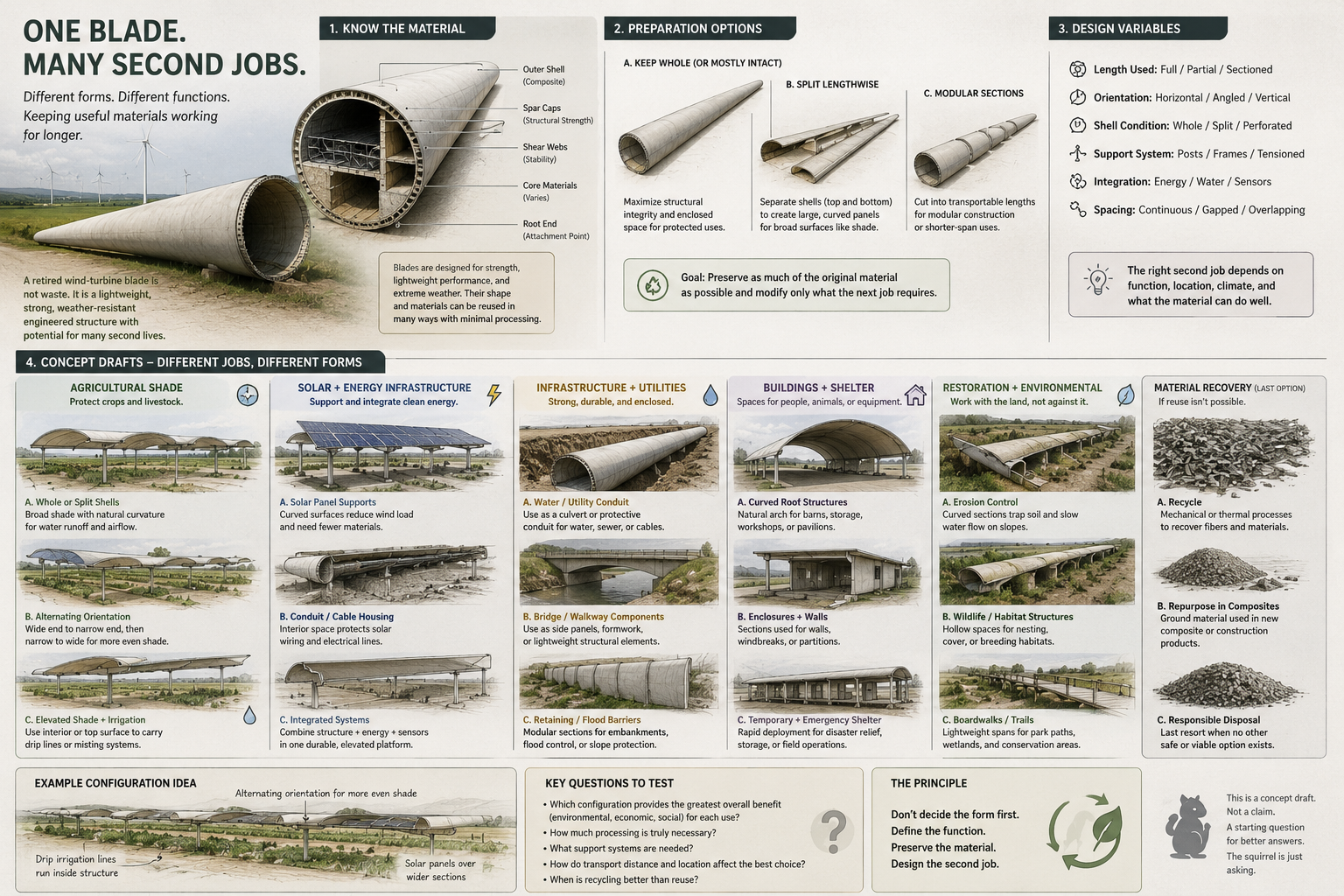
Wind-turbine blades are an interesting example because they are difficult materials. Much of a wind turbine can already enter conventional recycling streams, while its composite blades remain more challenging. Yet difficult to recycle does not necessarily mean useless. Retired blades have already been investigated and used for second-life structural applications, including bridges.
Researchers have also developed geographically detailed models of wind-blade end-of-life pathways. NREL’s CELAVI work, for example, has modeled wind-blade circularity in Iowa and Missouri using real locations and transportation routes. [5][6]
That research also demonstrates an important limitation: circular does not automatically mean sustainable. A reuse or recycling pathway can still create significant environmental impacts through transportation, processing, energy use, and supporting infrastructure. The entire lifecycle matters. That leads to a better question than simply asking whether something can be reused: Does this particular second use make more environmental and economic sense than the alternatives?
Agriculture, Solar, and Shade
My original thought was whether retired wind-blade sections could provide partial agricultural shade or serve some other role in agrivoltaic infrastructure. Agrivoltaics—the co-location of solar energy and agriculture—is already an active field of research. Solar arrays can coexist with crops, livestock grazing, native vegetation, and pollinator habitat. Researchers are studying crop performance, soil conditions, water use, panel height and spacing, farm-equipment access, economics, and ecological effects.
Research in China and elsewhere has also shown that photovoltaic structures can alter the microclimate beneath them. Under certain conditions, shade can change soil temperature, reduce evaporation, increase soil moisture, and affect vegetation establishment. Those results vary considerably by climate, ecosystem, crop, and system design. [9][10]
Agrivoltaic systems also require structures. Raising panels high enough for equipment or livestock can increase structural and engineering requirements. That creates another potential research question: Could appropriate certified recovered materials provide some of those structural functions? Maybe recovered steel could. Perhaps retired wind-blade sections have useful nontraditional applications. Maybe the engineering, transportation, or installation requirements make them completely impractical. That’s why this is a research question rather than a proposal.
Today’s Renewable Energy Is Tomorrow’s Material Stream
The question also has to look forward. Solar energy helps address today’s energy and climate challenges, but solar installations are still physical infrastructure. Panels, racking, electrical components, foundations, and supporting structures will eventually reach the end of their original jobs.
The EPA estimates that the United States could accumulate as much as 10 million total tons of end-of-life solar panels by 2050. Some panels may be suitable for direct reuse, repair, or refurbishment. Others will need recycling or disposal. Supporting infrastructure may remain useful even after the original panels are replaced. We know this material stream is coming. That gives us an opportunity previous generations often did not have: we can plan for it. [11]
Solar parking canopies are a simple example. They use already-developed land to generate electricity while also shading pavement and vehicles. But we can think beyond the panels themselves. Could some appropriate recovered materials be used to construct future canopies? Can the supporting structure remain when panels are replaced? Can systems be designed for easier disassembly? Can components receive another useful life afterward? Renewable infrastructure can solve today’s problem while still being designed with tomorrow’s material problem in mind.
Not Every Next Job Has to Be for Humans
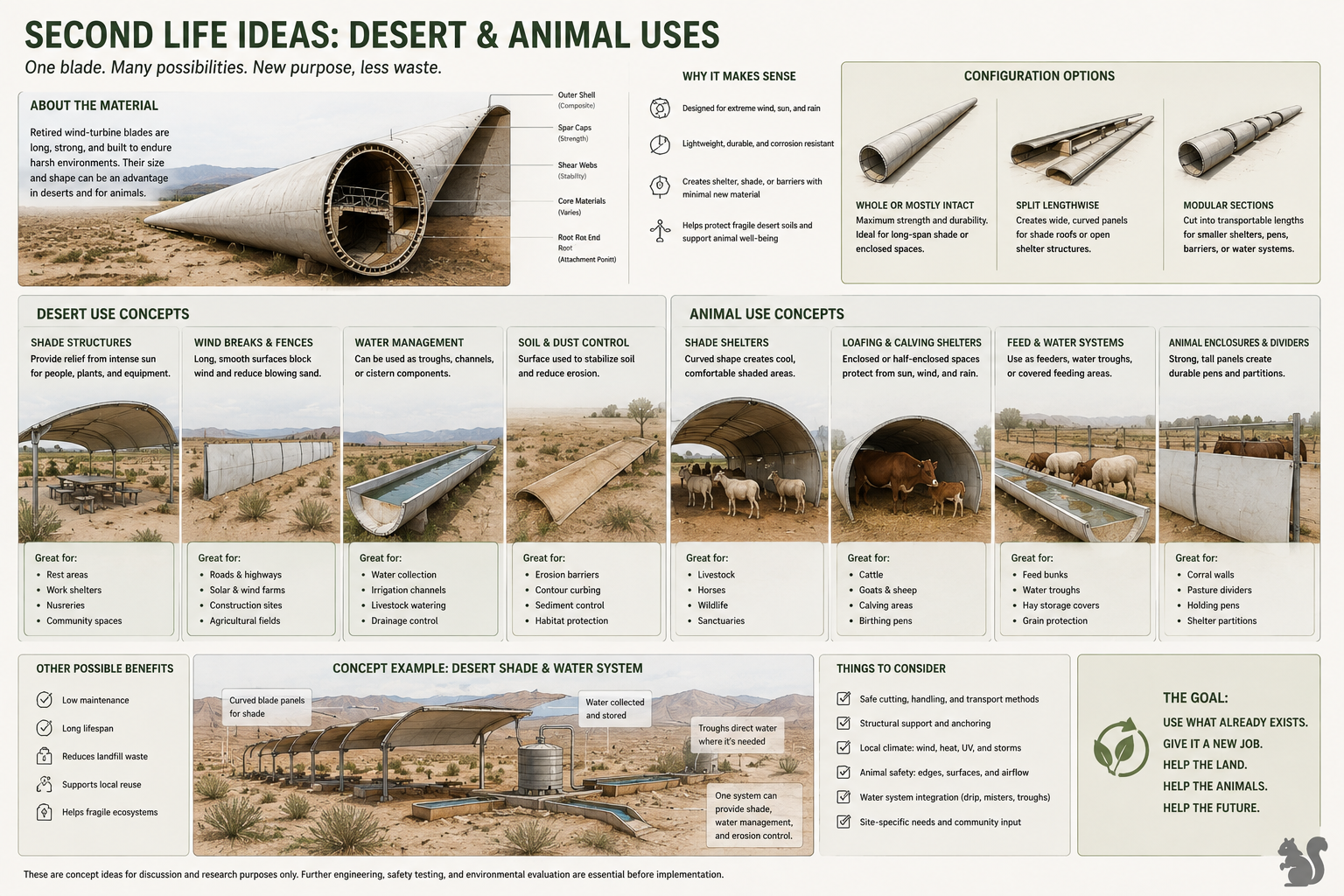
Potential second-life value does not have to be measured only by human economic production. Scientists already use carefully designed interventions to restore degraded landscapes and are studying how shade, soil treatments, moisture, renewable-energy infrastructure, and artificial refuges affect plants and wildlife.
That does not mean unused materials should simply be placed in natural environments. Deserts, grasslands, wetlands, forests, and prairies are functioning ecosystems, not empty spaces waiting for human improvement. An intervention that helps one degraded landscape could damage another healthy ecosystem.
The appropriate research question is therefore not Where can we put this material? It is: Can this material provide a measurable ecological benefit here without causing greater environmental harm? Perhaps in certain circumstances recovered infrastructure could contribute to restoration, erosion control, thermal refuge, or vegetation establishment. Perhaps recycling would be better. Sometimes the correct environmental intervention will simply be to leave an ecosystem alone.
A Material Network
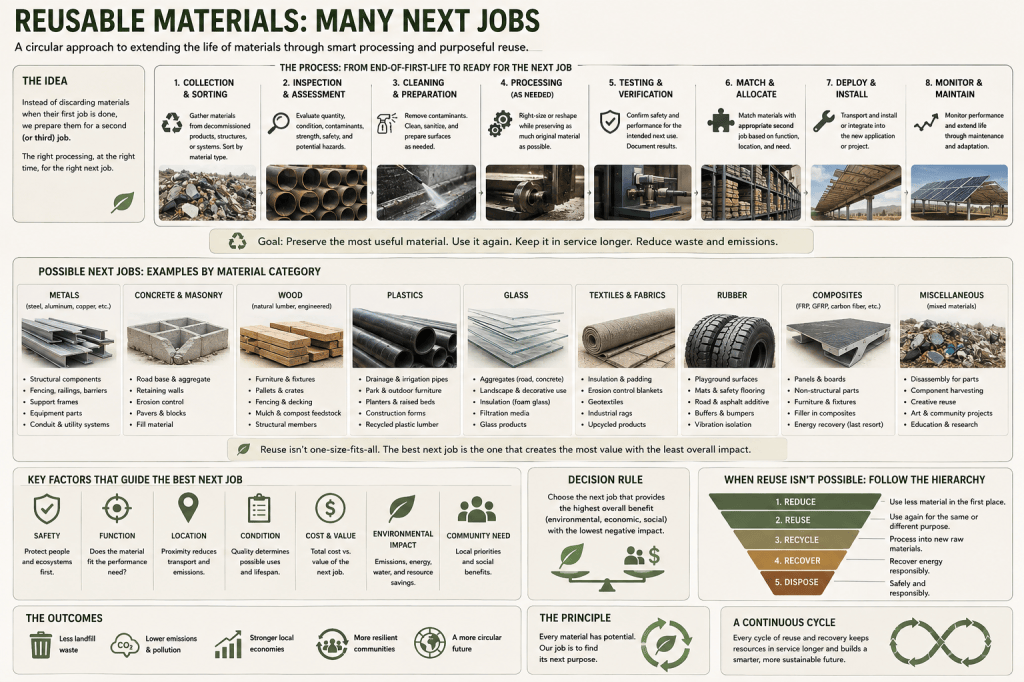
Eventually this becomes a logistics problem. A perfectly reusable beam is worthless to another project if nobody knows it exists. Even if someone knows it exists, reuse may not make sense if transporting, storing, inspecting, or modifying it costs more—financially or environmentally—than another option.
Material passports and exchange platforms already solve pieces of this problem. Geographic lifecycle models solve others. Combining those concepts raises the possibility of a system that knows what a material is, where it is, when it will become available, what condition it is in, what it could safely become, and where future demand might exist. The system could then compare possible pathways based on cost, environmental impact, transportation, processing, timing, and remaining useful life. [3][4]
That doesn’t require one enormous national warehouse full of old stuff. A national information system could support regional physical networks, with different materials operating at different geographic scales.
Let Geography Decide
The most useful locations for storage, inspection, processing, or material exchange may not always be major cities. Some smaller communities have freight rail, highway connections, industrial land, agricultural activity, manufacturing infrastructure, or access to ports and inland waterways. In other cases, metropolitan-edge facilities may make much more sense.
There is no reason to decide that in advance. Map where materials will become available. Map future demand. Add transportation networks, processing facilities, storage costs, environmental impacts, and land requirements. Let the data identify useful locations.
Transportation mode should be treated the same way. Heavy recovered materials are often not time-sensitive. U.S. freight rail can move a ton of freight roughly 470 miles on a gallon of fuel and is substantially more fuel-efficient than trucking, while waterways can also efficiently transport heavy bulk freight. However, loading, unloading, transloading, route availability, dimensions, scheduling, and final-mile transportation all matter. Sometimes a truck will make sense. Sometimes rail may win. Sometimes a barge or intermodal combination may be better. Don’t assume. Calculate.
Could the Network Serve Other Needs?
A distributed material network raises other possibilities worth studying. Governments and organizations already operate regional systems for disaster supplies and emergency response. Could certain inventoried, inspected, documented construction materials also have a role in longer-term rebuilding or resilience planning?
Perhaps. Storage costs may make the idea impractical. It may work for only certain materials or regions. But the larger principle remains the same: knowing what we have, where it is, what condition it is in, and what it can safely do creates options that do not exist when materials are treated only as waste.
The Goal Isn’t to Reuse Everything
This is the part I think matters most. The goal is not to keep everything out of a landfill at any cost. Transporting a giant component across the country simply to say it was reused may be worse than recycling it locally. Testing and recertification may sometimes cost more than replacement. Materials degrade, some contain hazardous substances, and certain applications require reliability that recovered components cannot provide.
A responsible system would compare recovery, inspection, processing, storage, transportation, installation, remaining useful life, maintenance, environmental impact, new-material production, recycling, and eventual disposal. Sometimes Job #2 will exist. Sometimes it won’t. Finding out that recycling is the better choice is still a successful answer.
So What Are We Actually Asking?
Research already exists on circular supply chains, wind-turbine blade reuse, structural-steel reuse, deconstruction, material passports, material exchanges, agrivoltaics, solar-panel reuse and recycling, ecological restoration, geographic lifecycle modeling, freight transportation, and design for disassembly. The pieces already exist.
My squirrel lives in the space between them.
Could decommissioning and demolition forecasts be connected to future construction demand? Could recovered structural materials reduce some of the new material needed for renewable-energy, agricultural, or heat-mitigation infrastructure? Could GIS and transportation modeling determine when reuse actually makes environmental and financial sense? Could we design infrastructure today with its second job already in mind?
What changes when we stop treating the end of one project’s life as completely separate from the beginning of another?
Take the Squirrel
This is not an engineering proposal, a business plan, or a claim that every idea here will work. It is a collection of existing research and systems that made me wonder whether useful questions are hiding in the spaces between disciplines.
Study it. Model it. Test it. Change it. Prove part of it or disprove the whole thing. If none of it works, we learned something. If one small piece works, we learned something too.
And if somebody takes the squirrel and turns it into something genuinely useful for the world someday, wonderful. You can buy me a coffee. I’m always happy with a coffee.
The squirrel has been released. 🐿️
References
[1] U.S. Environmental Protection Agency. “Sustainable Management of Construction and Demolition Materials.” Updated March 18, 2026. https://www.epa.gov/smm/sustainable-management-construction-and-demolition-materials
[2] U.S. Department of Energy. Circularity for Secure and Sustainable Products and Materials: A Draft Strategic Framework. October 2024. https://www.energy.gov/sites/default/files/2024-10/circularity-for-secure-sustainable-products-materials-report.pdf
[4] Port Economics, Management and Policy. “Building Blocks of Material Exchange Platforms.” https://porteconomicsmanagement.org/pemp/contents/part3/ports-circular-economy/building-blocks-of-material-exchange-platforms/
[5] “The Circular Economy Life Cycle Assessment and Visualization Framework: A Multistate Case Study of Wind Blade Circularity in United States.” Resources, Conservation & Recycling, 2022. https://www.sciencedirect.com/science/article/abs/pii/S0921344922003676
[6] Inventory Recovery. “Wind Turbine Decommissioning & Blade Recycling: 2026 Playbook.” https://invrecovery.org/wind-turbine-decommissioning-blade-recycling-2026-playbook/
[7] U.S. Department of Energy. “Agrivoltaics: Solar and Agriculture Co-Location.” https://www.energy.gov/cmei/systems/agrivoltaics-solar-and-agriculture-co-location
[8] U.S. Department of Agriculture, Economic Research Service. “Common Ground for Agriculture and Solar Energy.” April 2024. https://www.ers.usda.gov/amber-waves/2024/april/common-ground-for-agriculture-and-solar-energy-federal-funding-supports-research-and-development-in-agrivoltaics
[9] Peer-reviewed field research on photovoltaic arrays, soil moisture, soil temperature, and desert vegetation in western China (2021). https://pubmed.ncbi.nlm.nih.gov/33400111/
[10] Peer-reviewed research on photovoltaic development and greening across major deserts in China (2022). https://www.sciencedirect.com/science/article/abs/pii/S0301479722019119
[11] U.S. Environmental Protection Agency. “End-of-Life Solar Panels: Regulations and Management.” Updated July 31, 2026. https://www.epa.gov/hw/end-life-solar-panels-regulations-and-management
[12] U.S. Geological Survey. RestoreNet research on dryland restoration and seedling establishment. https://www.usgs.gov/publications/restorenet-emerging-restoration-network-reveals-controls-seeding-success-across
[13] U.S. Geological Survey. Research on improving biocrust colonization and establishment in dryland restoration. https://www.usgs.gov/publications/addressing-barriers-improve-biocrust-colonization-and-establishment-dryland
[14] Association of American Railroads. “Freight Rail Facts & Figures.” https://www.aar.org/freight-rail-facts-figures/
[15] Association of American Railroads. Positive Environmental Effects of Increased Freight by Rail Movements in America. June 2020. https://www.aar.org/wp-content/uploads/2020/06/AAR-Positive-Environmental-Effects-of-Freight-Rail-White-Paper-62020.pdf
An Open Invitation
If you’re a researcher, engineer, planner, or curious person who sees something worth investigating here, this squirrel is for you. Take it somewhere. Mama Mothy would love to hear about it.

