The Squirrel Files / File #002
Different Minds, Same Classroom
What started as research for I Wonder How Your Mind Works collided with a real-life experience my daughter had at school.
It started with a book. Then my daughter came home from school.
I was already writing I Wonder How Your Mind Works, a book exploring something I’ve become increasingly fascinated by: how differently people can experience their own minds, and how easily we assume other people experience thinking the same way we do.
Then my daughter ran into a situation at school that collided directly with something I had been teaching her.
She noticed the contradiction immediately. She came home and told me. And suddenly I had a problem to solve.
I didn’t want to ignore what had happened. But I also didn’t want to approach the school in a way that suggested my daughter had done something wrong, blamed her teacher, or turned one classroom interaction into something larger than it needed to be.
So I did what I tend to do when I don’t know the answer. I followed the squirrel.
What began as How do I address this particular situation? became a much larger question: What happens when the language we use to teach assumes that everyone experiences thinking the same way?
That question led into research on mental imagery, aphantasia, inner speech, auditory imagery, silent reading, visualization as a learning strategy, perspective-taking, reading comprehension, intervention, and what it means when a student is trying but still isn’t progressing.
Eventually, the original problem became Different Minds, Same Classroom: a research-supported letter for educators and four quick-reference guides designed to turn the research into something useful in an actual school.
But the squirrel wasn’t finished. While following those sources, another question kept appearing: if people can differ this much in whether they consciously experience pictures, words, sounds, or other representations while thinking, what does thinking actually feel like inside different minds—and how does cognition work when those conscious experiences aren’t there?
That research trail became the fourth book in my I Wonder How Your Mind Works lineup.
What This File Contains
Educator Letter
A research-supported letter written for teachers and school staff, grounding the conversation in what the science actually says about cognitive diversity.
Classroom Guide — Aphantasia
For students who experience little or no voluntary mental imagery. What that means, how it might show up, and how to support it.
Classroom Guide — Inner Speech Variation
Exploring the range of inner voice experiences students may have and why it matters for learning and self-regulation.
Classroom Guide — Reading & Comprehension Differences
How different minds process text, construct meaning, and what educators can do to meet more learners where they are.
Letter to the School
TDifferent Minds, Same Classroom
What happens when we stop assuming everyone thinks the same way?
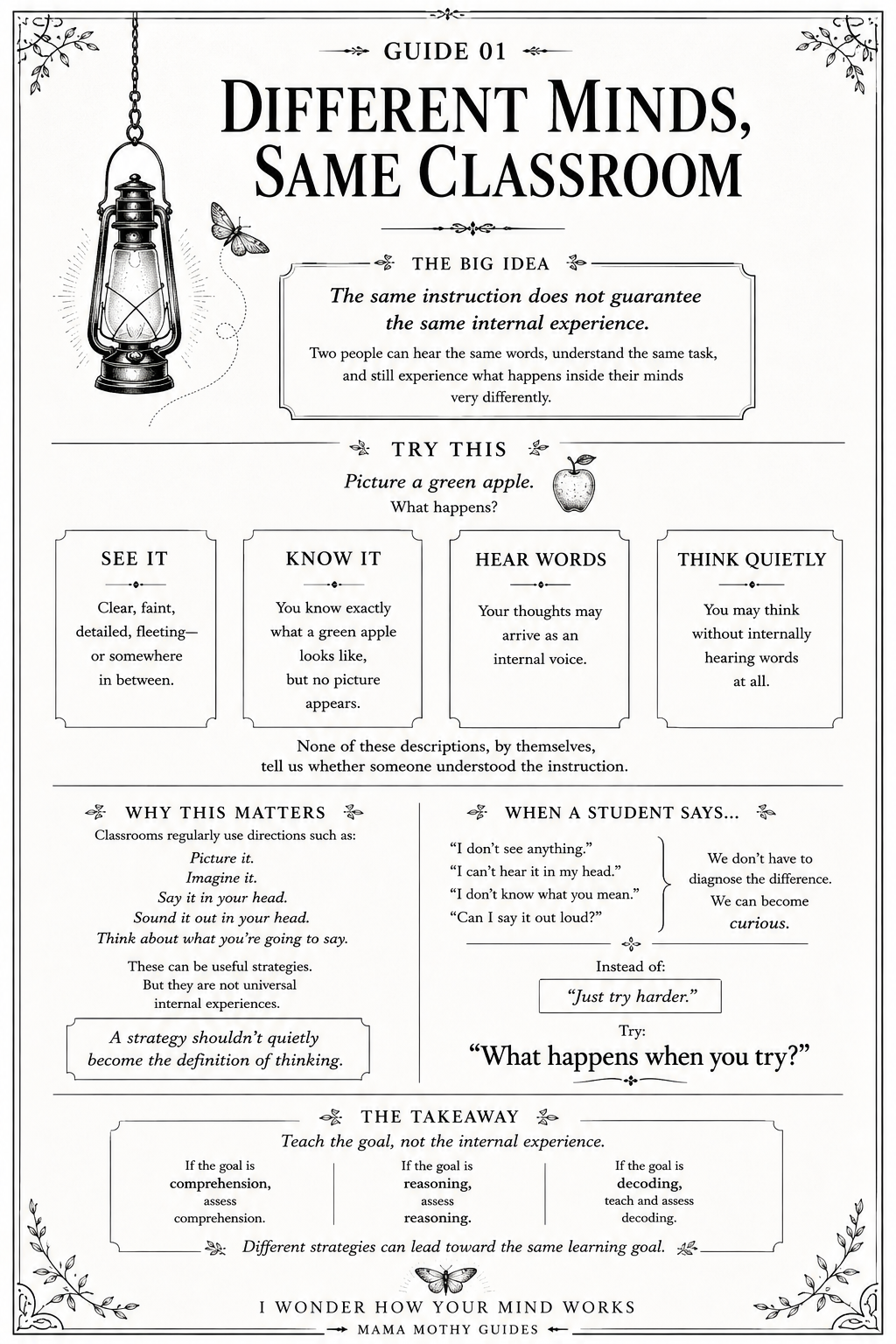
Every day in classrooms, we ask children to think about it, picture it, imagine it, sound it out, or read it in their head. These are such ordinary instructions that most of us probably don’t stop to think about what we’re actually asking a child to do. We know what those words mean to us. We know what happens in our own minds when someone says them. Somewhere along the way, without really meaning to, we start assuming that something similar must happen in everyone else’s mind too.
But what if it doesn’t?
Take something as simple as a green apple. If I ask you to picture one, maybe you can see it clearly. Maybe it’s a little fuzzy. Maybe you can rotate it, make it bigger, or change it from green to purple. Maybe an image appears but doesn’t stay still. Maybe you can create the apple but can’t easily change it. Maybe you get something vague or incomplete.
Or maybe there was never an apple there to begin with.
You can still know what an apple is. You can recognize green when you see it with your eyes. You understand what purple means. You can understand perfectly well what I’m asking when I tell you to imagine a purple apple. But understanding the instruction does not guarantee that an internally visible purple apple appears.¹
That sounds almost impossible when your own mind does the opposite. I know, because discovering how differently people experience thought is one of the reasons I began researching and writing I Wonder How Your Mind Works. The farther I went, the stranger some very ordinary words became: think, picture, imagine, hear, remember.
Mental imagery varies. Inner speech varies. Auditory imagery varies. The ability to voluntarily create, maintain, manipulate, or experience internal sensory representations can vary too. And those differences don’t necessarily travel together neatly. Someone might experience vivid visual imagery but little internal speech. Someone else might experience a nearly constant stream of words. Another person may experience conscious thought without experiencing those thoughts as internally spoken sentences or pictures.²
That last one can be particularly difficult to conceptualize. How can a mind be quiet if someone is still thinking?
The easiest analogy I have found is imperfect, but useful. Imagine a desktop computer that is turned on and running. Turn off the monitor. Now turn off the speakers. The computer didn’t stop processing information because there is no visual or auditory output. Things are still happening underneath.
Obviously, a human brain isn’t a desktop computer, and this isn’t intended as a neurological explanation. It is simply a way of separating two ideas we often unintentionally combine: thinking and consciously experiencing thought as pictures or sound are not necessarily the same thing.
A quiet mind can still think.
A person can also look at words physically printed on a page and understand them without recreating those words visually somewhere inside their mind or internally hearing a voice read them. An exclamation point is still understood as an exclamation point. A question mark is still understood as a question mark. The reader understands what the punctuation communicates, but may not internally hear the change in volume, emphasis, or tone another reader experiences automatically. Reading the sentence aloud can create a completely different experience because now there is actual sound available to hear.³
The presence or absence of an internally heard reading voice does not, by itself, tell us whether that person understood what they read.
And that is where an interesting conversation about how strange human minds are becomes important in a classroom.
You Can’t Ask About a Difference You Don’t Know Exists
I remember asking about this once.
I was in first grade, and we were writing our own books. Mine was about Barbie, because apparently six-year-old me already had important literary contributions to make. We were supposed to imagine or picture something for the story, and I couldn’t do it. I remember telling my teacher, “I can’t see anything. I don’t understand what you’re asking me.”
I wasn’t trying to explain aphantasia. I didn’t know the word. I didn’t know there was anything unusual about what I had said. I was a little kid trying to explain, as literally as I could, that whatever I was being asked to see simply wasn’t there.
The interaction made me feel stupid.
So I stopped asking.
Looking back at that moment as an adult is strange because now I understand something six-year-old me didn’t: when my teacher told me to picture something, she may have actually meant picture it.
For most of my life, picture this meant think about this. Imagine meant consider an idea or possibility. I interpreted those words through the only mind I had ever experienced—mine. Why would I have asked whether another person was actually producing something resembling a picture inside their mind? I didn’t know there was a question to ask.
Children enter classrooms with that same limitation. They know what it feels like to be themselves.⁴
A child with vivid imagery has no automatic reason to know another child doesn’t experience it. A child with constant internal speech has no reason to know another person’s mind may be quiet. A child without voluntary imagery may assume everyone understands picture it as a figure of speech. Everyone can use the same words—think, imagine, remember, picture, hear—without realizing they may be describing very different experiences.⁵
That makes “just ask if you don’t understand” more complicated than it sounds. A child can understand an instruction perfectly according to their definition of the words and still misunderstand the internal experience the adult intended.
And a six-year-old probably isn’t going to raise their hand and say, “Excuse me, I believe my subjective experience of voluntary visual imagery may differ from yours.”
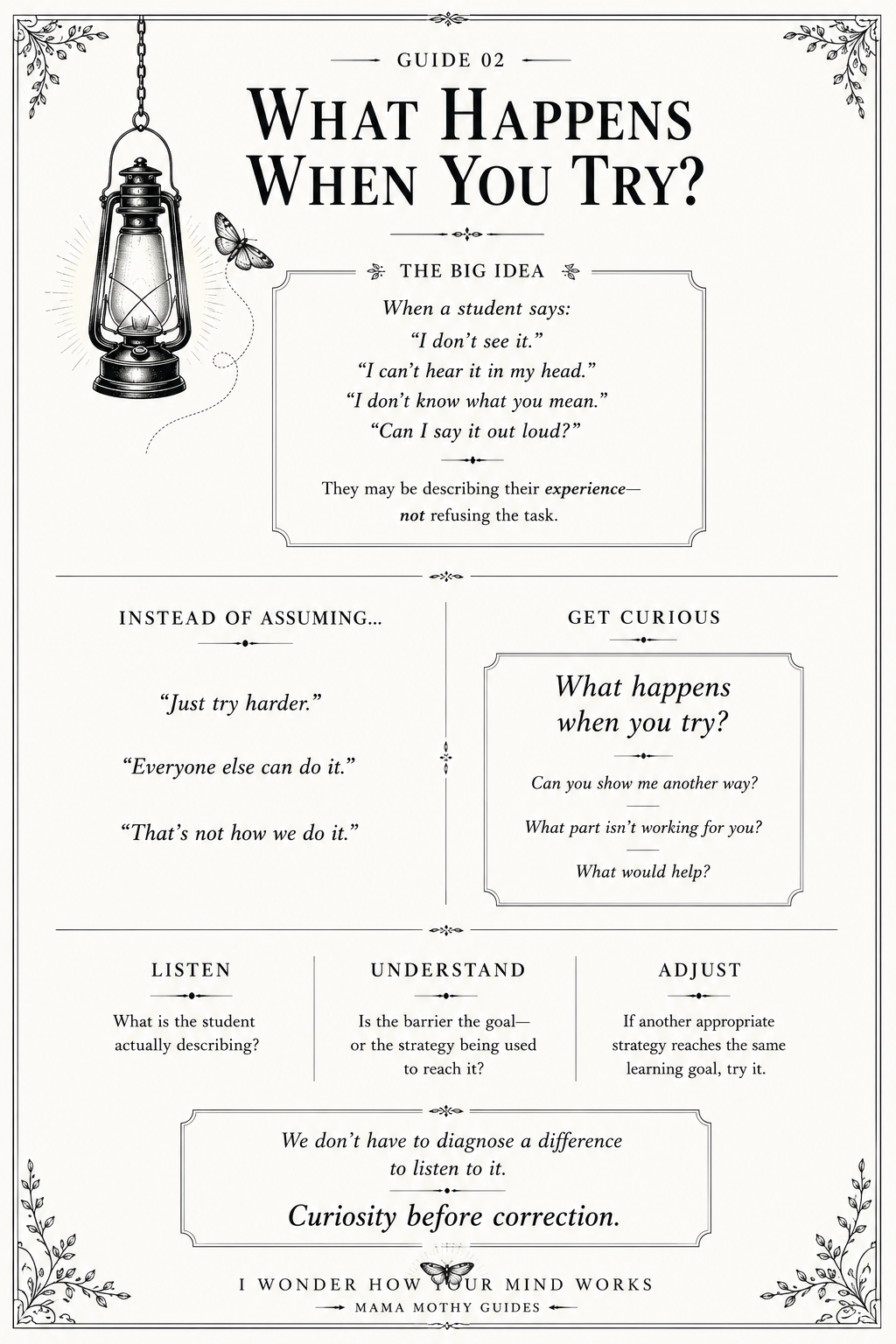
They’re going to say, “I don’t see anything.”
Maybe, “What am I supposed to see?” Or, “Can I say it out loud?” “I can’t hear it unless I say it.” “What do you mean, in my head?”
Or simply:
“I don’t know.”
Sometimes those statements will mean a child is confused. Sometimes they need more instruction. Sometimes they’re distracted or avoiding the work. But sometimes they may be giving us the only description they have for an internal experience they don’t yet have the vocabulary to explain.
We don’t have to diagnose the child to become curious. Sometimes the next question can simply be:
What happens when you try?
Schools are already doing some of this work. Educators help children understand how they approach learning—what helps them engage, how they respond to difficult work, whether visual supports help, how pacing affects them, which strategies help them organize information, and what happens when they become frustrated.
That’s valuable. But there is another question underneath it that we don’t seem to ask nearly as often:
What happens inside your mind while you’re learning?
A student can know visual aids help without knowing whether they voluntarily create mental images. They can prefer written directions without realizing another student may internally hear those words while reading. They can know talking through a problem helps without understanding why. One student might need time before answering because they’re internally rehearsing language.⁶ Another may discover what they’re trying to say by saying it.
We can give children language for how they learn while also giving them permission to become curious about how they experience thinking.
Not another test. Not another label. Not another box.
Just a question.
When a Strategy Becomes the Standard
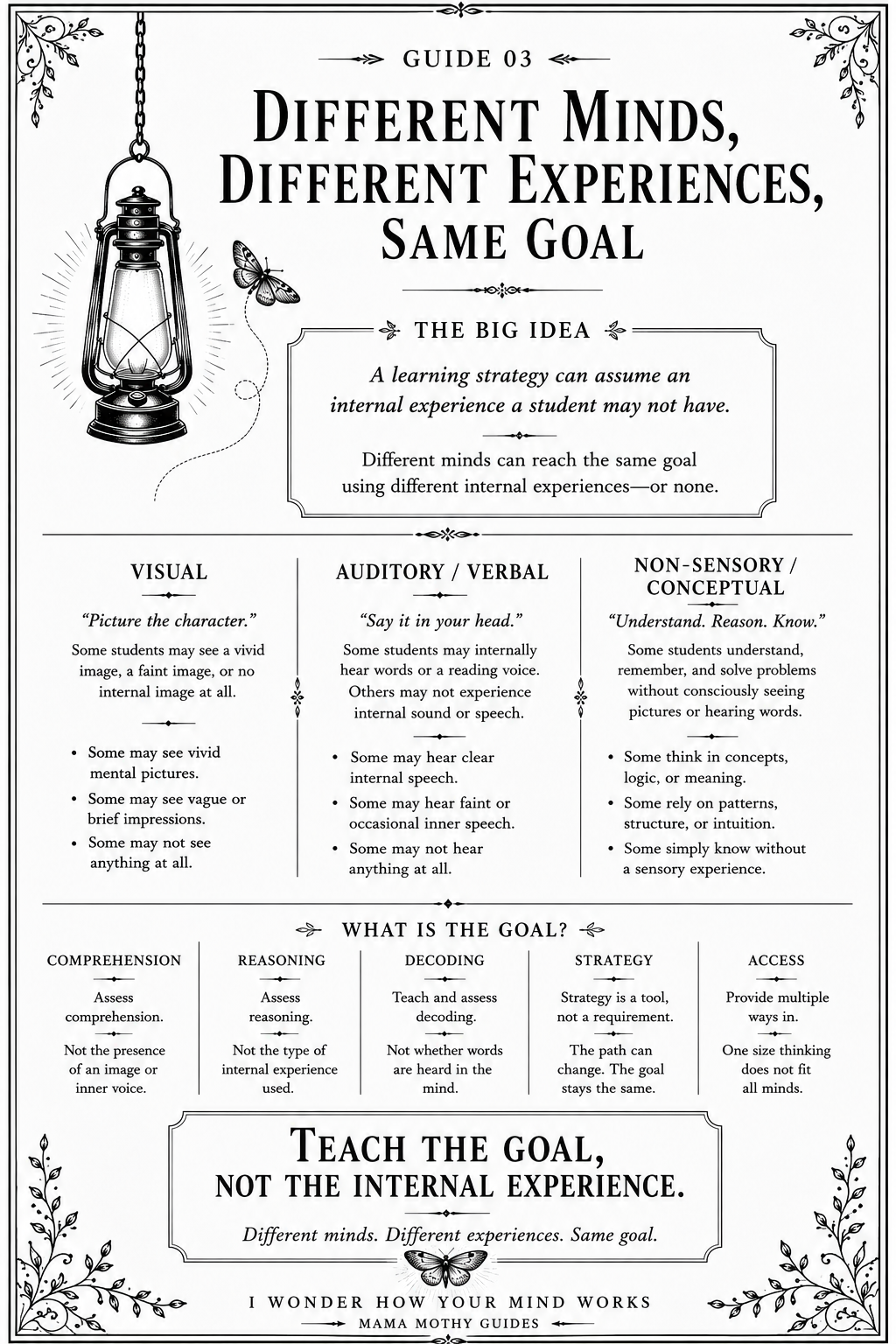
Visualization can be a useful reading strategy. Internal verbal rehearsal can be useful. Reading aloud can help. Drawing can help. Physical manipulatives and external visual supports can help. None of those strategies is the problem.⁷
The problem begins when successful use of one strategy quietly becomes evidence that a child is thinking correctly—or trying hard enough.
Consider visualization.
We’re not simply talking about two groups of people: those who visualize and those who don’t. Imagery itself can vary. One person’s may be vivid and detailed. Another’s may be faint. Someone may experience an image that’s difficult to maintain. Someone may create an image but struggle to manipulate it—to rotate something, move it, or change its color. And another person may report no voluntary visual image at all.⁸
Now imagine telling all of those students:
Picture the character wearing a blue coat. Now change the coat to red.
They may all understand exactly what you’re asking.
They are not necessarily beginning with the same internal tool.
The same problem can occur with say it in your head, sound it out in your head, or think about what you’re going to say before you speak. These may be perfectly reasonable strategies for students whose internal experiences support them. But we have to be careful about turning the ability to perform the strategy into a measurement of effort.⁹
Effort and internal experience are not the same thing. A student may be trying very hard without being able to produce the particular internal experience a strategy assumes.
That is why the learning objective matters.
If the goal is reading comprehension, assess comprehension. If the goal is mathematical reasoning, assess reasoning. If the goal is decoding, teach and assess decoding. If visualization itself is genuinely the skill being taught or studied, that’s different. Then visualization is appropriately part of the objective.
But a strategy shouldn’t quietly become the definition of thinking.
Teach the goal, not the internal experience.
And if we’re going to teach children to advocate for themselves, we also have to make their answers safe for adults to hear.
If a child learns to say, “I don’t see pictures when I do that,” and the response is, “Of course you do. Just try harder,” we haven’t taught self-advocacy. We’ve taught the child that their description of their own mind is wrong.
An educator doesn’t need to determine why the experience is different. They don’t need to diagnose aphantasia or identify a particular form of inner speech. In fact, a student’s comment alone shouldn’t be used to do either of those things.
Sometimes the response can simply be:
“Okay. Tell me what happens when you try.”
We can even normalize variation before anybody has to disclose anything. A teacher can tell the whole class, “We’re going to try visualizing this scene. Some of you may get a really clear picture, some may experience something faint, and some of you may not get much of a picture at all. That’s okay. We’re using visualization as one way to help us understand the story. If it doesn’t help you, we’ll try another way.”
Nobody has been singled out. Nobody has been diagnosed. Nobody has been told visualization is bad.
But somewhere in that classroom may be a child realizing:
Oh. I’m not doing it wrong.
And everybody else just learned something equally important:
Not everybody’s mind works like mine.
Curiosity Is an Educational Tool
There is one more piece of this that matters to me: what happens when a student really is trying and isn’t progressing?
As a child, I struggled significantly with reading, spelling, and language. Years later, I read some of my old educational records as an adult. One recommendation for improving my reading over the summer was essentially: read more books.
On its face, that’s perfectly reasonable advice. Want to improve at reading? Read.
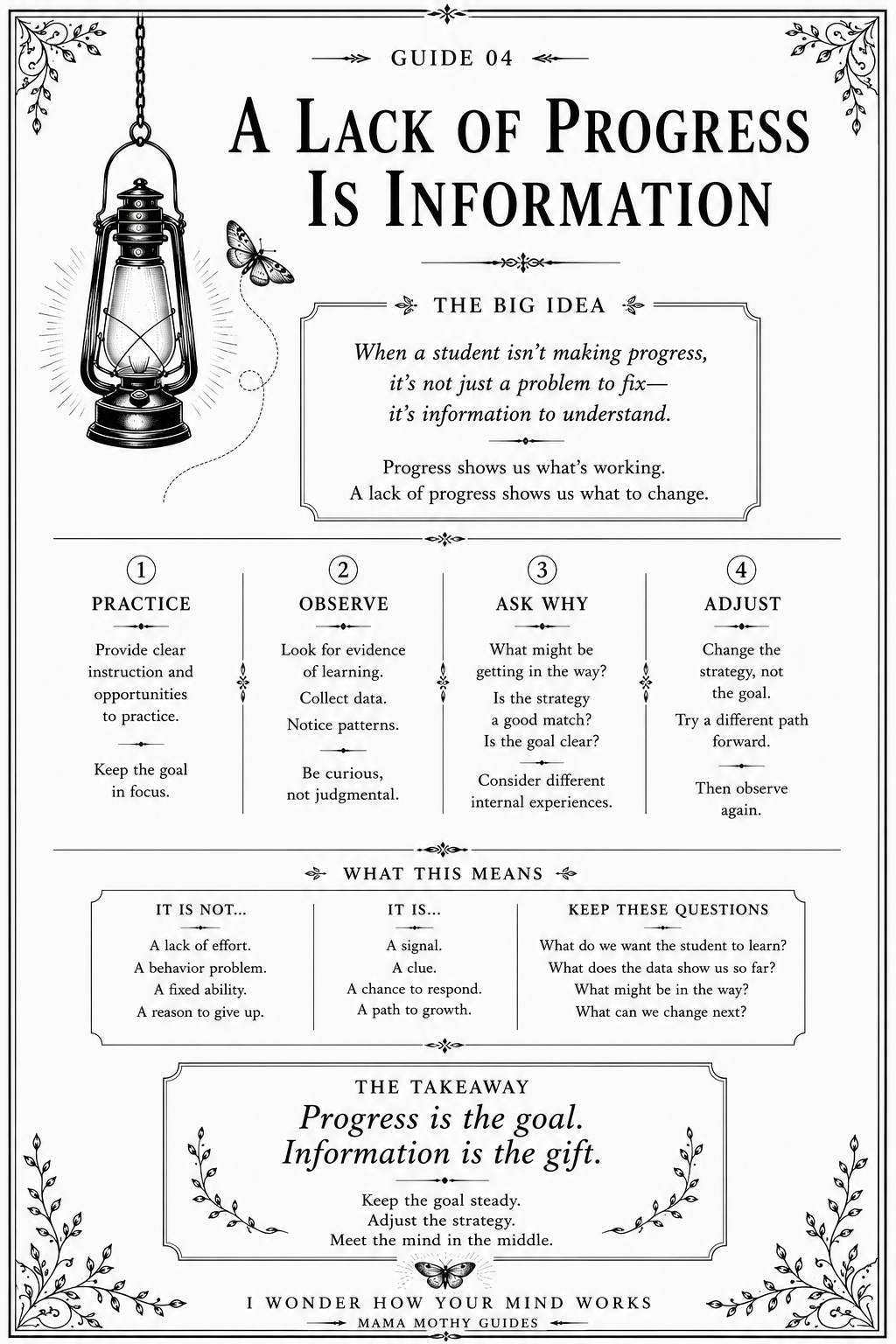
But there is a point at which repeating an intervention without meaningful growth should give us new information.¹⁰
If a student practices and practices and the expected growth isn’t happening, more practice may help. But it may also be time to ask why. Perhaps a foundational skill is missing. Perhaps the instruction or strategy isn’t meeting that student’s needs. Perhaps another factor is interfering with learning.
A lack of progress doesn’t tell us which explanation is correct.
A lack of progress is information.
It tells us to become curious.
IEPs, 504 plans, evaluations, accommodations, interventions, and specialized instruction serve important purposes. There are circumstances where formal support is absolutely necessary.
But listening to a child doesn’t require paperwork.
Asking what happens when they attempt a strategy doesn’t require a diagnosis. Recognizing that another appropriate route may exist doesn’t always require us to know exactly why the first route wasn’t working.
A diagnosis can unlock formal support. Curiosity shouldn’t require one.
I’m not asking teachers to determine the cognitive profile of every student. I’m not asking schools to stop teaching visualization. I’m certainly not suggesting that every difficulty is caused by differences in internal experience.
I’m asking us to be careful about something all humans naturally do.
We spend our entire lives inside one mind.
Of course our own experience becomes our reference point.
But a classroom is full of minds.
Some may be loud. Some may be quiet. Some may be vivid. Some may be abstract. People may rely on language, imagery, spatial relationships, external supports, or combinations of processes that aren’t obvious to someone watching from the outside.¹¹
We can observe a child’s behavior. We can assess their performance. We can listen to their answers.
What we cannot do is stand outside another person’s mind and automatically know what thinking feels like inside it.
So when a child describes something that doesn’t make sense according to our own experience, perhaps we don’t immediately correct their description.
Maybe we become curious.
Maybe we ask:
What happens when you try?
Because before children can understand their own minds, they need to know that there is something worth asking about. And before we ask children to advocate for how their minds work, the adults around them need to know that those differences are possible.
Sometimes the most useful educational question may also be the simplest:
I wonder how your mind works.
Notes
1. David G. Pearson et al., “Assessing Mental Imagery in Clinical Psychology: A Review of Imagery Measures and a Guiding Framework,” Clinical Psychology Review 33, no. 1 (2013): 1–23, DOI; Adam Zeman, Michaela Dewar, and Sergio Della Sala, “Lives without Imagery—Congenital Aphantasia,” Cortex 73 (2015): 378–80, DOI.
2. Johanne S. K. Nedergaard and Gary Lupyan, “Not Everybody Has an Inner Voice: Behavioral Consequences of Anendophasia,” Psychological Science 35, no. 7 (2024): 780–97, DOI; Georgia A. Floridou, Kaya J. Peerdeman, and Rebecca S. Schaefer, “Individual Differences in Mental Imagery in Different Modalities and Levels of Intentionality,” Memory & Cognition 50 (2022): 29–44, DOI.
3. Ruvanee Vilhauer, “Characteristics of Inner Reading Voices,” Scandinavian Journal of Psychology 58, no. 4 (2017): 269–74, DOI.
4. Susan A. J. Birch et al., “Perspectives on Perspective Taking: How Children Think about the Minds of Others,” Advances in Child Development and Behavior 52 (2017): 185–226, DOI.
5. Birch et al., “Perspectives on Perspective Taking”; Pearson et al., “Assessing Mental Imagery”; Nedergaard and Lupyan, “Not Everybody Has an Inner Voice.”
6. Marcela Perrone-Bertolotti et al., “What Is That Little Voice inside My Head? Inner Speech Phenomenology, Its Role in Cognitive Performance, and Its Relation to Self-Monitoring,” Behavioural Brain Research 261 (2014): 220–39, DOI.
7. Mina C. Johnson-Glenberg, “Training Reading Comprehension in Adequate Decoders/Poor Comprehenders: Verbal versus Visual Strategies,” Journal of Educational Psychology 92, no. 4 (2000): 772–82, DOI; Inge E. Boerma, Suzanne E. Mol, and Jelle Jolles, “Reading Pictures for Story Comprehension Requires Mental Imagery Skills,” Frontiers in Psychology 7 (2016): 1630, DOI.
8. Pearson et al., “Assessing Mental Imagery”; Zeman, Dewar, and Della Sala, “Lives without Imagery—Congenital Aphantasia.”
9. Nedergaard and Lupyan, “Not Everybody Has an Inner Voice”; Vilhauer, “Characteristics of Inner Reading Voices.”
10. Stephanie Al Otaiba, Richard K. Wagner, and Brett Miller, “‘Waiting to Fail’ Redux: Understanding Inadequate Response to Intervention,” Learning Disability Quarterly 37, no. 3 (2014): 129–33, DOI; Timothy Shanahan, “How Not to Respond to a Lack of Responsiveness to Intervention,” Shanahan on Literacy, article.
11. Kathryn F. Knight, Fraser Milton, and Adam Zeman, “Aphantasia and Visual Working Memory: No Direct Evidence of Impaired Visual Working Memory in Aphantasics, Either in Behavioral Performance or the Accuracy of a Multivoxel Pattern Classifier,” Neuropsychologia 226 (2026): 109he full text of the letter written for the school will appear here.
The Unexpected Path
This squirrel didn’t stay in its lane. The deeper the research went, the clearer it became that these questions — about how minds work, how we imagine, how we talk to ourselves — belong in the books too. File #002 became a significant influence on the direction of Book 4.
Some squirrels lead somewhere you didn’t plan to go. That’s the point.
Have a squirrel of your own?
Mama Mothy offers independent research services — credible sources, existing research, related ideas, and the places your question might lead.

